

Article Summary
- The biggest long-term storage risks are moisture swings, fine dust, and handling/scuff damage.
- A proper piano cover is the most realistic day-to-day protection you can maintain for months.
- Moving blankets fail because they shift, leave gaps, and can hold dust and odors against the finish.
- In garages, the right plan is cover + moisture control + periodic inspection.
- For maximum protection, heavy-duty quilted mackintosh is the best all-around material; vinyl can be a good wipe-clean option.
Long-term piano storage isn’t just “keeping it out of the way.” Over weeks and months, small issues compound: moisture swings, fine dust settling into seams, and accidental bumps when people move items around. The practical default is a cover-first approach: use a piano cover that fits, stays put, and protects the whole instrument consistently, then support it with basic climate control and periodic checks.
The biggest risks in long-term piano storage
If a piano sits untouched for months, the main threats are environmental and routine. Moisture swings are the biggest long-term risk because they affect wood movement, felt, and how the instrument holds regulation. Fine dust is next, because it migrates into seams and collects on lower parts like pedals and legs, even when the room “looks clean.”
The third risk is human handling. Storage spaces change over time, and pianos are often bumped by boxes, tools, furniture, or moving carts (we see this a lot in schools and churches for example). Even careful people scuff corners and rub finishes when navigating tight spaces.
A cover addresses these realities better than most improvised options:
- Reduces dust settling on the lid, key area, legs, and pedals.
- Buffers minor scuffs from boxes and day-to-day traffic.
- Encourages consistency because it’s easy to keep on for months.
Garage vs. spare room vs. climate-controlled unit: what changes
The correct storage plan depends on the stability of the environment. A spare room inside the home is usually the easiest scenario because temperature and humidity tend to be more stable. A climate-controlled storage unit can work well if it truly maintains consistent conditions and the unit is clean and dry.
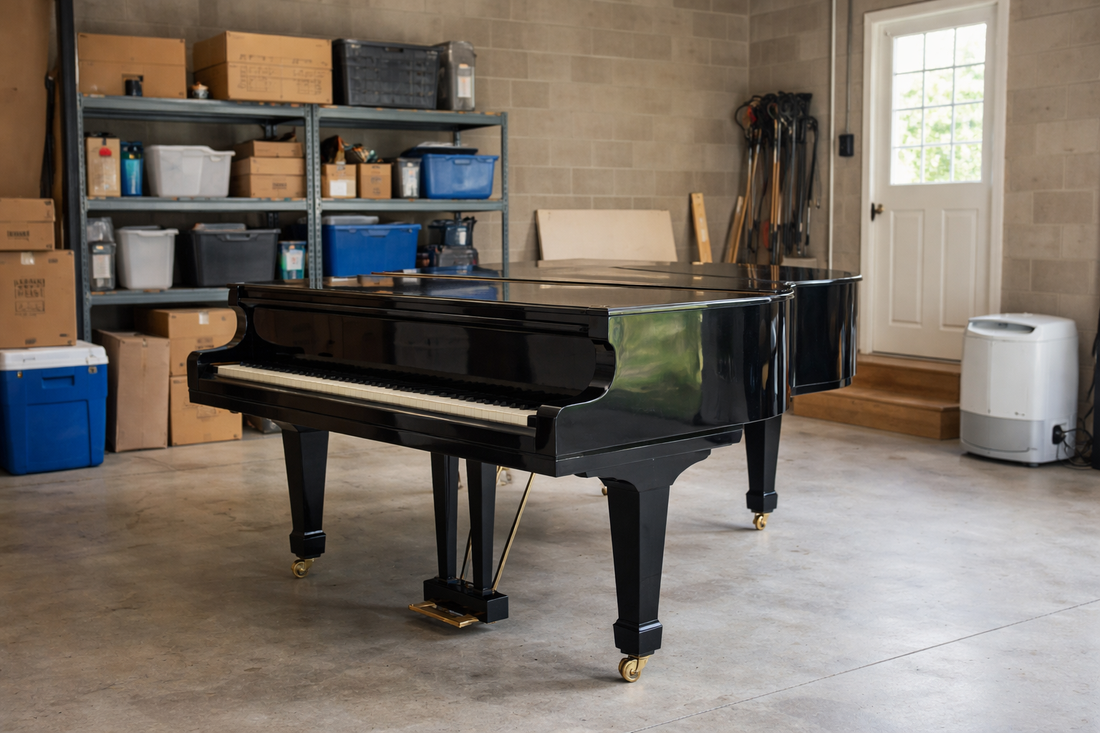
A garage is the toughest scenario because it often has larger temperature swings and more airborne dust. Garages also have higher odds of odors and tracked-in debris. If you must use a garage, your priority is reducing exposure and stabilizing moisture as much as reasonably possible.
Do you need a dehumidifier, and what to monitor
You don’t need to turn storage into a science project, but you do need basic moisture awareness. If the space feels damp, smells musty, or has visible condensation at times, moisture control becomes a priority. A dehumidifier can be helpful in a garage or damp spare room because the goal is consistency, not “bone dry air.”
If you want a deeper, practical breakdown of what covers can (and can’t) do in humid environments, see: Do Piano Covers Protect Against Humidity?
What to do in practical terms:
- Use a simple humidity monitor so you’re not guessing.
- If humidity runs high for long periods, a dehumidifier is often worth it.
- Avoid sealing the piano in plastic for months; it can trap moisture and odors against the finish.
- Keep the piano away from exterior doors, leaky windows, and direct floor moisture.
A cover supports moisture management by reducing dust buildup and reducing how often you touch and wipe the instrument. It does not “fix” a damp space, but it helps you keep the piano protected while you control the environment around it.
How a full-length cover helps with moisture:
- A full-length cover reduces airflow-driven dust and drafts reaching the lower case, pedals, and underside areas.
- It can reduce rapid exposure to small, localized drafts (door opens, vents, fans).
- But it will not dehumidify the space or “seal out” humidity. If the room is damp, the piano will still equilibrate over time.
Does a cover prevent musty odors, and why moving blankets fail
A cover can help reduce musty odors indirectly by limiting what settles on the piano and by reducing contact with dusty surfaces. But odors are mostly an environmental problem. While a cover does help, if the storage area is musty, the piano will eventually smell like that space. The fix is improving the room environment, not relying on a tarp or blanket to “seal it out" (and you do not want to seal a piano, as it would trap the moisture).
Standard moving blankets fail in long-term storage for predictable reasons:
- They shift and sag, exposing corners, legs, and the pedal area.
- They leave gaps where dust and debris migrate in over time.
- They can hold dust and odors against the finish during long storage.
- They offer inconsistent coverage because they’re not patterned to the piano.
A properly fitted piano cover is designed for stable, repeatable protection. It stays in place, covers the whole instrument, and makes “leave it protected for months” realistic instead of fiddly.
How a floor-length piano cover helps with odors:
- Full-length coverage can reduce the piano acting like a “dust collector,” which reduces the amount of odor-carrying dust settling on surfaces.
Which cover material is best for long-term storage
For long-term storage, you want three things: consistent coverage, a practical barrier against dust, and protection against incidental bumps. For that reason, heavy-duty quilted mackintosh is the strongest all-around choice for storage because it adds padding while still functioning as a serious protective cover for months at a time.
Full-length coverage is also worth considering for storage. It helps protect lower surfaces (legs, pedals, and underside edges) from dust settling and from contact in cluttered spaces. It can also reduce exposure to drafts and airflow that carry dust through storage rooms. It won’t completely “solve humidity” or block odors in a damp space, but it does improve day-to-day protection where storage environments tend to cause the most wear.
Use these simple rules:
- Best for long-term storage (overall): Heavy-duty quilted mackintosh for padding plus strong everyday protection.
- Good for wipe-clean protection: Vinyl, especially if the space is dusty and you want an easy-to-clean surface.
- What to avoid: thin “universal” covers that shift and leave gaps, and plastic tarps that trap moisture/odors and require constant re-taping.
Fit matters as much as material. A cover that is made to fit stays aligned and reduces gaps around corners, legs, and pedals. That’s where higher-quality, American-made covers typically outperform cheap imports in real storage conditions.
For a step-by-step way to choose the right cover type and fit for your piano, use the Piano Cover Purchasing Guide
Storing a piano in a church or school storage room
Church and school storage rooms are a common “in-between” environment: not as exposed as a garage, but often less stable and less controlled than a spare room in a home. HVAC may run on a schedule, doors open frequently for events, and the space can be shared with risers, chairs, music stands, and cleaning supplies. That combination increases dust settling and the chance of incidental bumps.
In these settings, a cover-first plan matters because responsibility is shared. You can’t assume everyone will remember to be careful, or that the piano will stay clear of stacked items. The most practical protection is consistent full coverage that stays in place day after day.
What works best in a church/school storage room:
- Use a properly fitted cover so it doesn’t shift when people move items nearby.
- Consider a full-length cover to protect legs, pedals, and lower surfaces where dust settles and where contact happens in crowded rooms.
- Choose a robust material for storage, especially if the room is used for staging; heavy-duty quilted mackintosh is the best choice because it adds padding and holds up well during long periods of storage.
- Keep the area around the piano clear so nothing leans against the rim, legs, or pedal lyre. A note on top of the piano saying not to place boxes on top of the piano can also be helpful, so that it does not become a storage shelf.
Recommended options by scenario
- Spare room in your home: Cover-first protection with heavy-duty quilted mackintosh for long-term padding and consistent coverage.
- Climate-controlled unit: Cover-first protection; consider vinyl if you want easy wipe-clean protection in a shared facility.
- Garage storage: Cover + moisture control + inspections; heavy-duty quilted mackintosh is the best default due to bump risk and dust.
- Workshop-adjacent storage: Prioritize full coverage and padding; keep it away from active work paths and inspect more often.
If you’re storing a piano for months, the protection that actually holds up is the protection you can keep in place every day. A properly fitted cover helps reduce dust settling, buffers minor scuffs, and makes long-term storage simpler and safer. For grand pianos, browse Grand Piano Covers and choose a material like heavy-duty quilted mackintosh for the most robust storage protection.


